Showing posts with label article copyright and all rights reserved Snehith Kumbla. Show all posts

Saturday, 25 November 2017

The Rupin Pass Himalayas Trek May-June 2017: Buras Kandi to Dhanrashi / Lower Waterfall (Day #7)


The experienced Himalayan campaigner, Aditya, guides me before I set foot on my first snow trek.

What was my prior reference point to trekking on snow? Commercial Hindi films. Bollywood movies have made walking on snow feel like dancing on your best friend's wedding. I mean, even way back in Junglee (1961), Shammi Kapoor rolled, crashed and drowned in the snow without any visible injury, while shouting a thunderous, "Yahoo!" to go with it. As for Sridevi swaying in a thin yellow saree in Chandni (1989) to Rishi Kapoor's sweater-draped romp over the definitely chilly Switzerland hills, well they must have paid her damn well for that craziness.

Walking on Snow: Alertness the Key 
Cutting back to reality, believe me, Hindi film fans and my other dear readers, you are on your own here. How hard snow, melting snow or crushed snow responds to your shoe grip can be tricky. The best thing for beginners is to stay alert and ensure a firm grip with every step. I had my faithful companion, a walking stick. It was a stout lengthy dark branch of a tree that a villager at Jakha had cut to the right size, scrubbing it's one end to a rough bluntness. The stick made for great support, especially during the testing snow hikes.

Crampons, to be fixed to the boots for superior grip on prolonged snow walks, were provided on the vital day of the thrilling summit climb, but more on that later.


Himalayan Magic: Melting Snow, Gushing Stream
We arrive at the Lower Waterfall camp after another tough but enjoyable day of trekking. That the air was getting thinner at 12000 ft was evident now. I tread cautiously, catching my breath after a set of dozen steps and then moving ahead.

Many of us were carrying our own backpacks. What we ate, how much we ate, how much energy needed to be conserved, precautions to not fall sick, protective layers of clothing, drinking warm water, were now important factors. Keeping conversation to the minimum while trekking - another good idea for unhindered breath.

The waterfall was gushing as a result of the steadily melting snow. It was no longer in the icy white, frozen form that I had seen on the Internet image searches. In fact, by evening, the stream beside the camp had doubled in volume and width. Jokes on flooding and imminent death followed.

It was unlikely though for the stream to swell through the night and engulf us all. Surely, the weather would grow colder and the melting ice would pause until sunrise to continue its age-old cycle.We were all still alive, dry when morning arrived, to the tinking of the bells around the porters' grazing mules. An icy flood, a timely escape, and an exciting rescue mission ending with steaming hot chocolate cups would have made a great story though, at least on paper.


One, with the Mountains 
To be at par with the adjoining mountains during the acclimatization climb treats us to another great waterfall and a grand view. It is truly as if we were in the age when gigantic beasts ruled the earth and gods at war flung huge weapons of lightning, piercing the earth and creating mountains. Climbing up fast and joyously, it is here that I am finally confident and convinced that nothing will deter me from enjoying every step of the trek to follow, from making the final summit climb.


Another majestic waterfall greets us at the Lower Waterfall camp, falling from a great height, making midgets of mighty rocks.


Our tents seem like a distant, unknown village while gaining height during the acclimatization climb. 


The first sun rays slice the top of the mountain into two shades. It is an epic sight, imagine watching a miniature tilted, revolving earth, lighting up from within. That's what it felt like.

Wednesday, 25 May 2016

Bob Dylan turns 75


On May 24, 2016, the multifaceted, enigmatic, 'the man of the thin growl voice', the mesmerizing banyan tree of a songwriter, protest singer, folk-singer, harmonica-round-the-neck man - Bob Dylan, turned 75. If compared to a very commercial Hindi film song sequence, Dylan wears and discards many of his superhero to ordinary man costumes in the space of one song at a time.

Now, we may not call him a free-flowing great singer like Lata Mangeshkar, but the culmination of his wispy voice and sheer power of his elevating songwriting (what beautiful, searing poetry!) makes him sort of a charming, caravan-living, mysterious traveler who sings all that he absorbs from life, whenever one listens to him. Here are the lines from one of the first songs that made him conspicuous, way back in the mid-sixties:

"Blowin' In The Wind"

How many roads must a man walk down
Before you call him a man ?
How many seas must a white dove sail
Before she sleeps in the sand ?
Yes, how many times must the cannon balls fly
Before they're forever banned ?
The answer my friend is blowin' in the wind
The answer is blowin' in the wind.

Yes, how many years can a mountain exist
Before it's washed to the sea ?
Yes, how many years can some people exist
Before they're allowed to be free ?
Yes, how many times can a man turn his head
Pretending he just doesn't see ?
The answer my friend is blowin' in the wind
The answer is blowin' in the wind.

Yes, how many times must a man look up
Before he can see the sky ?
Yes, how many ears must one man have
Before he can hear people cry ?
Yes, how many deaths will it take till he knows
That too many people have died ?
The answer my friend is blowin' in the wind
The answer is blowin' in the wind. 


Wednesday, 30 October 2013

My Favourite Sachin Tendulkar One-Day Moment

The shot in the first ball of the fifth over off Caddick

It was against England in the initial group match of World Cup 2003 in South Africa that Sachin Tendulkar came out all guns blazing. Tendulkar had already scored 152 against Namibia, but then, you know, no offence, it was Namibia.(Although we proclaim it to be the Cricket World Cup, there are barely half a dozen competitive teams out of a playing dozen at any given time of the playing season.) Meanwhile Brain Lara had played a brilliant match-winning blinder (116) against South Africa in the inaugural match.   

Anyway, on February 26th, India were batting first.With Sehwag and Tendulkar opening, India were held back at 13/0 in four overs. It was a raw moment when something was bound to give away. 

First ball of the fifth over, Andy Caddick comes rushing in to Tendulkar. The ball bounces and rises head high between the middle and leg stump. For a batsman without anticipation that would have been a very awkward delivery. But what happens in the next few seconds is extraordinary. Somehow, Tendulkar seems to have half-anticipated the ball. He sways to off (feet still grounded one behind another in front of leg stump) and pulls the ball strong behind him, right in the middle of the bat. Intentionally as it was directed, the ball sails way in its trajectory above the wicket-keeper and just out of the diving fine leg fielder's reach to the boundary, one bounce, four! Also, Tendulkar loses his balance as he completes the shot and falls to his right in his batting crease. So apart from the prospect of a brilliant catch, Tendulkar also escapes getting hit wicket in what would have been, the most strange fashion. It is a decisive point in the entire World Cup and by the time he is nicked by Flintoff, Tendulkar had made exactly 50 and added tonnes of confidence.Later, Ashish Nehra bowls a mercurial spell to ensure that England never get to the chase. 

A 97 vs Sri Lanka and a masterful 98 vs Pakistan follow, he falls early in the final - India chasing a mammoth total against Australia and it takes another eight years for him to realise the ultimate cricketer's dream - The World Cup. 

But just the way Sachin Tendulkar pulls, falls and the ball agonizingly escapes the fielder in that first ball of the fifth over on February 26, 2003 sums up Tendulkar - enterprise, endeavour, adventure and a passion for batting that stood out beyond the obvious genius.           

Friday, 11 October 2013

Thank you Sachin Tendulkar


Sachin Tendulkar's prolonged retirement from all forms of cricket has finally come full circle. On October 10th, 2013 Tendulkar informed the Board of Control for Cricket in India (BCCI) that he shall hang up his boots after playing in his 200th test in November at the Wankhede against the West Indies. Tendulkar had already announced his retirement from one-day cricket and T20 earlier. 

It made poignant reading in today's newspapers; out of the verbiage the little master's words stood out, telling us of the Sachin Tendulkar of the present,"It's hard for me to imagine a life without playing cricket...it's all I have ever done since I was 11."      

With the announcement many childhood memories have slid to nostalgia mode. Much has changed since Tendulkar's 1989 test debut against Pakistan. Test match cricket was king then, in 2013 the format is threatened with the commercial, marketing blitz and assured financial ticket that T20 and IPL have become for cricketers and cricket control boards.

Sachin in our lives   
In all our years of childhood, adolescence and youth, Sachin Tendulkar stood out as a folk hero and a very tangible one for that. The advent of quality television broadcasting, improved camera angles and commentary also provided an enhanced view to the proceedings. Here was a sporting hero whose exploits we could experience at the time that it was happening. 

Older generations will thus understand our disconnection when they say that Sunil Gavaskar was a better batsman. We just weren't around when Gavaskar was straight driving and playing without the helmet, facing fearsome bowling attacks. Sachin Tendulkar was inevitably in many of our life moments, a surge in each masterly shot he played, the affirmation that things were possible.

More than Tendulkar's genius it was the intensity and confidence that stood out. Between expectation and fulfillment of all our dreams, Tendulkar was the sole bridge for many years. Even as his curly haired youth brought a fort like mid-thirties the batsman gave it all he had. 

Freeze Frame 
There shall be more, but to conclude this article, I shall give you a word image of what I think is the best photograph that has ever been taken of Sachin Tendulkar. I hope to share the photograph, if I come across it again. The photo appeared in India Today around the time when Sachin's career was its zenith, he had already played those cult, reputation-affirming one-day Sharjah 1998 knocks against Australia. The photo is devoid of any action, it merely shows in its concise frame, Tendulkar's in his test whites seated on a plastic chair, with the helmet, pads and gear on, ready to battle. The appearance is one of stillness, but the eyes are a giveaway, they are almost fiery, pointed, and warrior like. Complete with the arms wrapped around himself, it is a rare moment of culmination - of youth, adventure and domination. So long Sachin and thank you very much for the mastery and the memories.   

Wednesday, 12 December 2012

Ravi Shankar & Allah Rakha make magic at Monterey, 1967


Ravi Shankar had never played at a pop festival before till Monterey. He finally agreed to do so, it seems, on the insistence of George Harrison, one of the four famed members of The Beatles.

Harrison had been the most influenced of the group by Indian instruments.

He went on to learn the Sitar from Ravi Shankar. Beatles fans would concur - listen to Within You, Without You, Love You To and Norwegian Wood as evidence and listening pleasure.

Shankar arrived at Monterey two days before he was scheduled to play.

He almost thought of not playing, witnessing firsthand the atrocious onstage behaviour of some rock stars, one of them was legendary guitarist Jimi Hendrix - burning his guitar and throwing it to the audience.

Ravi Shankar was shocked to see this. He regarded the instrument as a friend, an artist burning his guitar was an unbelievable sight.

Ravi Shankar woke up to a dark rainy morning and it was afternoon when the rain stopped and he began playing, accompanied by Tabla maestro Allah Rakha and Kamala Dasgupta on the Tanpura.

The collage above is clipped from a YouTube video of the artists playing Dadra and a fast teental, the final piece from the Shankar full set on that day.

This 19 minute magical piece, "a light classical melody," as Shankar calls it in the introduction, consists of a main tune that is decorated with improvisations of folk and other tunes.

Allah Rakha is at his best, the result is a rare uplifting epic creation.

Here is the YouTube video of this masterpiece. Allow the video to load fully for immersive, uninterrupted listening pleasure.

Wednesday, 1 February 2012

Jaipur Literature Festival 2012: Listening to Gulzar

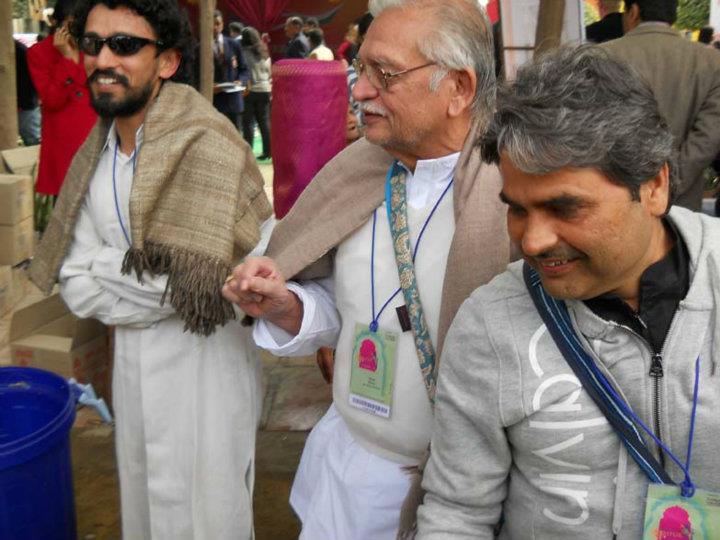
Gulzar with his collaborator Vishal Bharadwaj (noted filmmaker & music directorat the festival

20/1/2012 

How well can you translate Gulzar’s works into English? Writer and diplomat Pavan K.Varma has walked the tight rope to do the same. As a result, in a brand new bilingual poetry collection, we have Gulzar’s Hindi originals on the left side of the page, to Varma’s English translations of the same, on the right. 

The story behind the book: One day, after a long gap, Gulzar abruptly called up Varma and told him, “As several of my poems have been lying neglected for the need of publication, we shall call this collection – Neglected Poems.” What was thus uttered frivolously came  to be the book title. Gulzar and Varma alternatively read some selections at the post lunch session on January 20th 2012 at the Mughal Tent. The session was named after a popular Gulzar song: Do Deewane Shehar Mein.

The audience that had accumulated at the venue was all ears to the poet’s rendition. Those who couldn’t find seats positioned themselves near the speakers, and were content to take in each word. Some sat with their eyes closed, some held up their recording devices even as Gulzar’s mellow voice flowed through the gathering. Varma’s translations did show that the work was in good hands.
Then there was a rare insight of the poet into New York, as his keen eye notices that there are no ants in the American city. Gulzar's words are translated here by this blog writer: “I dropped some sugar, but not a single ant came.” He continued, “There are plants here, flowers and beautiful trees…but I didn’t see a bee hovering over any flower…there are no leakages on the wall here, hence no cracks on the wall, at our place there are the leaves of Peepal sprouting from the cracks..”

Full of camaraderie and laughter, both Varma and Gulzar were also narrating anecdotes in between the readings. As Varma revealed, he was jostling with one of the difficult poems of the poet, and was in either a good or bad mood when he was doing his work. Gulzar used to send over some SMSes to cheer him up. One of them read:

Muddat huvee hai yaar se 
cheers kiye huve, 
Ghalib ne ab ke Eid pe 
kya sharaab chod di 

(It has been a while since
we said cheers,
has Ghalib discarded alcohol
this Eid?)

Even as the crowd roared in laughter, Gulzar chuckled and said that he would like to see how his friend would let out his other secrets… 

This wonderful, evocative session on poetry made a great start to what was the first day of the Jaipur Literature Festival 2012. 

Saturday, 29 September 2007

Cosmic Nad: the pulsating beat of Kathak

Sheetal Kolwalkar, Kaveri Agashe and Ketaki Phadke-Shah perform at the Jawaharlal Nehru Memorial Hall on 28th September, 2007.
( Click image for large size view )

28th September 2007, Friday
Raincloud is a freelancer, writing for The Times Of India, Pune supplements. These are four page supplements that are published three times a week. A bunch of freelancers have been assigned to make up for the content and photographs. Raincloud is one of them. So we happened to be at this event, I accompanied Raincloud out of sheer curiosity. A half-day arrangement for a month had been agreed upon at my workplace, in the process of shifting to another job.

Cosmic Nad, a Kathak dance group was performing for a NGO - Prashanti Cancer Care Mission (PCCM).We were at the Jawahar Lal Nehru Memorial Hall, Camp just after 6 pm. It is an old hall and still standing. Not more than 50 people were there. We scramble through the darkness and take the fifth row seats in the middle. Then we got dazzled by the art. The pulsating feet of the kathak dancers, the vocals, the gently looping sound of the harmonium, the breathtaking tabla.

It is a polished, delectable performance, emanating of youth, tradition, rhythm and tradition. An old world aura.  

*
Percussion
–noun
The striking of one body against another with some sharpness; impact; blow.

Here's a list of words that you can search for on the Internet or Wikipedia:
Kathak
Anklets
Ghungroo
Footwork
Improvisation
Chakras
Revolutions
Hand movements
Designs patterns